Support #2323
open

Question with regard to the variable nwage_dv
100%
Description
Dear Understanding Society Team,
I am working with household level income data and I would like to adjust that data with the number of working age people in a given household. However, I noticed that the nwage_dv variable has a significant portion of zeros for this variable.
How might this be possible as zeros indicate in my understanding that the number of working age people in a household are none.
I would appreciate a brief clarification.
Thanks, and have a good evening,
Best,
Nico
Files
 Updated by Understanding Society User Support Team about 1 month ago
- % Done changed from 0 to 50
- Private changed from Yes to No
Hi Nico,
I want to double-check if I correctly understand your question. Are you surprised by the number of household with no people in working age (i.e. the number surprisingly high)? Or is it "How can households have household income if no one is of working age?"
Thanks,
Piotr Marzec
UKHLS User Support
 Updated by Nico Ochmann about 1 month ago
Both!
Thanks Piotr for your reply and help.
Best,
Nico
Updated by Understanding Society User Support Team about 1 month ago
- File clipboard-202601291355-0yvfe.png clipboard-202601291355-0yvfe.png added
- Status changed from New to Feedback
- % Done changed from 50 to 60
nwage_dv is just a household headcount, not an employment or income measure. It’s created from the individual-level age_dv and sex_dv in w_indall.dta, then summed within household (hidp): within each household, it gives every person a 1 if they meet the working-age definition (female 16–59 or male 16–64) and 0 otherwise, then adds those up to produce the household’s total nwage_dv (see the Stata code for details: https://www.understandingsociety.ac.uk/wp-content/uploads/documentation/main-survey/syntax/stata/nwage_dv_public.do).
So nwage_dv = 0 simply means: no household members fall into those working-age bands (most are pensioner-only households).
And households with nwage_dv = 0 can still have non-zero household income, because the total household income variable also includes non-labour components such as pensions, benefits, and so on. When you compare different household income measures this becomes clearer. For instance, total household income (fihhmnnet1_dv) is >0 in almost all households regardless of nwage_dv, including those with nwage_dv=0, because it includes non-labour sources. By contrast, labour-only income (fihhmnlabnet_dv) is 0 in the majority of households where nwage_dv=0 and >0 in the majority of households when nwage_dv>0.
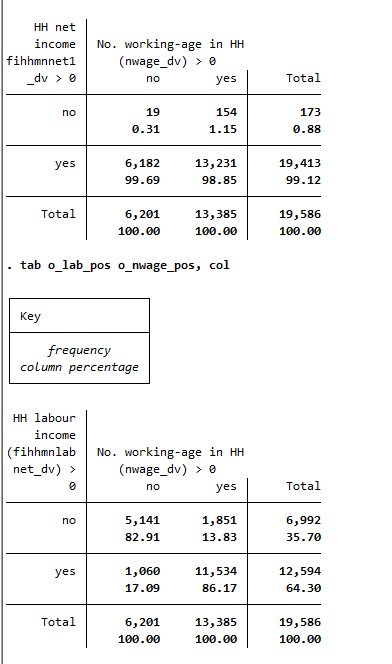
You can read more about income variables here: https://www.understandingsociety.ac.uk/documentation/mainstage/user-guides/main-survey-user-guide/household-income-variables/ and here: https://www.understandingsociety.ac.uk/research/publications/working-paper/understanding-society/2019-08/
I hope this helps.
Best wishes,
Piotr Marzec
UKHLS User Support
Updated by Nico Ochmann about 1 month ago
Great support, thanks a lot!
Best,
Nico
Updated by Understanding Society User Support Team 19 days ago
- Status changed from Feedback to Resolved
- % Done changed from 60 to 100